WHAT IS "TAKING THE GRRR OUT OF THE GROOMING SALON" APPROACH ALL ABOUT
 Sue Williamson
In this blog I will share with you what the Taking the Grrr out of the Grooming Salon is all about
Understanding Consent-Based Grooming: The Taking the Grrr out of the Grooming Salon (TTGOGS) Approach
As one of the first groomers to openly discuss consent-based grooming for dogs in a professional grooming environment, I’ve always felt it important to help other professionals understand what this approach truly means—especially through the lens of the Taking the Grrr Out of Grooming Dogs ethos.
As the founder of Taking the Grrr Out of the Grooming Salon (TTGOGS), consent-based handling sits at the heart of my work. My understanding of consent, however, originates from the dog behaviour world. I was first introduced to the concept by Chirag Patel (Domesticated Manners) while assisting him at a seminar where he taught the Bucket Game. That experience partly influenced how I work with dogs today.
What Consent-Based Grooming Really Means
Consent-based techniques begin by teaching dogs how to “play” specific communication games using positive reinforcement—typically food, but also toys, touch, or verbal praise. Once dogs understand the rules, they gain the ability to give and withdraw consent for grooming and handling tasks.
My Favourite Method: Table Protocol
Table Protocol is my personal favourite because it gives dogs genuine control. The dog chooses to be:
- On the table → grooming happens
- Off the table → grooming pauses
It may sound surprising, but dogs do choose to return to the table. Once they understand the process, most rarely choose to leave. To support this autonomy, I groom on a low table with steps so dogs can move freely, and I avoid using safety grooming aids that restrict movement. My behaviour background has taught me that movement is essential for anxious dogs.
Other Consent-Based Techniques
Bucket Game
Grooming continues while the dog looks at the bucket. When they break eye contact, grooming pauses until they re-engage.
Chin Rest
Ideal for face work. Grooming happens while the dog rests their chin in your non-grooming hand. When the chin lifts, grooming stops.
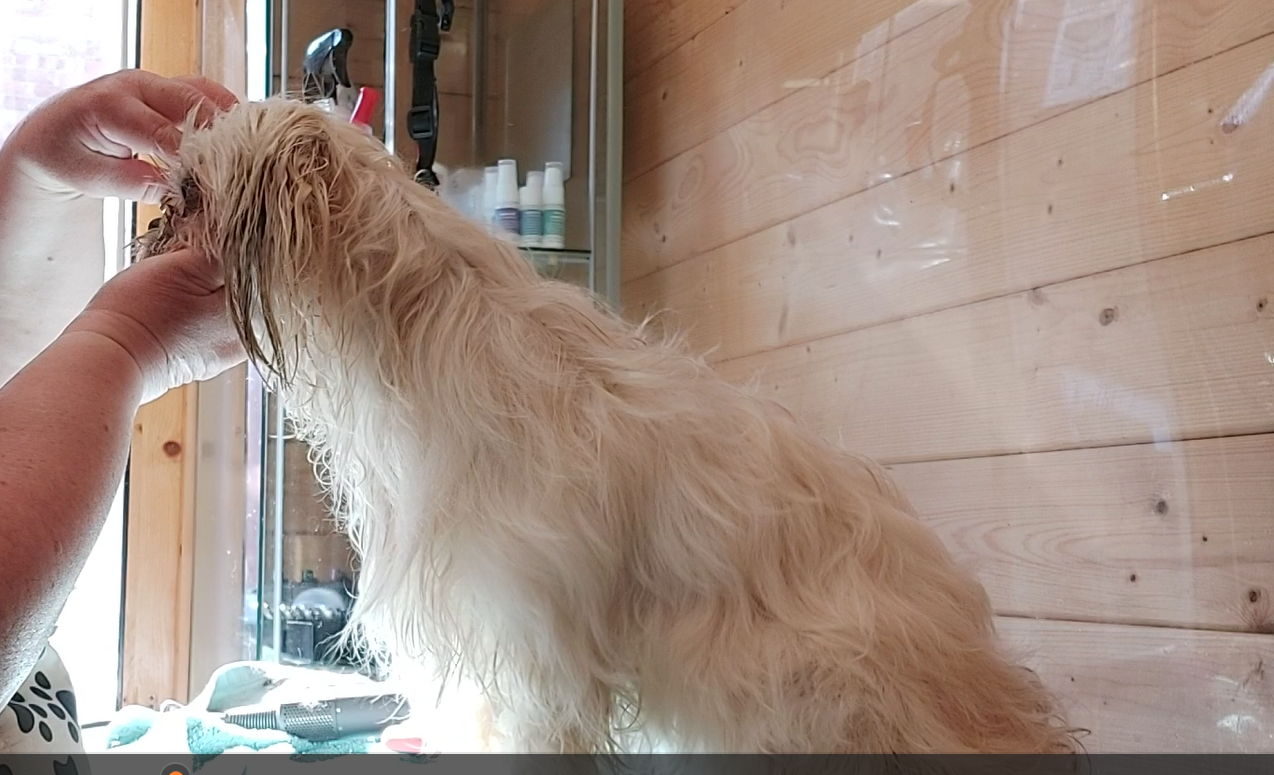
Mat Protocol
Similar to Table Protocol but on the floor. Grooming happens on the mat, pauses when the dog steps off, and resumes when they return.
Paws On Protocol
The dog places their front paws on a surface (table, stool, or even your knees). Grooming continues while paws are “on” and pauses when they come off.
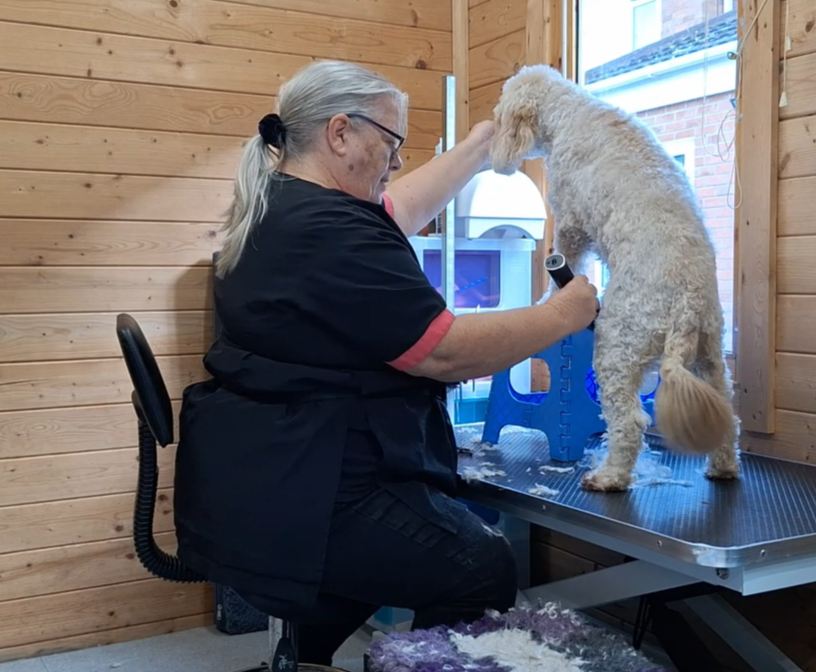
These techniques are simple to teach, and owners can support the process at home with clear guidance. Consent-based grooming also significantly reduces bite risk because dogs know they can stop the process without escalating to reactive behaviour.
What Consent Is Not
I’ve seen groomers claim that if you pick up a dog’s paw and they don’t pull away, they are “consenting” In reality, this could mean:
- The dog has been conditioned to tolerate paw handling
- The dog isn’t bothered by it
- The dog has learned that pulling away doesn’t work, so they’ve stopped trying
This applies to all body handling. Consent is not the absence of resistance—it is the presence of choice.
The Taking the Grrr out of Grooming (TTGOGS) Ethos
The TTOGS approach is far more than consent-based grooming. It integrates:
- Animal Centred Education (ACE) (Sarah Fisher)
- Tellington TTouch Training (Linda Tellington Jones)
- Low Stress Handling (Dr. Sophia Yin)
- Extensive canine behaviour and psychology
- Family Dog Mediator L.E.G.S. model (Learning, Environment, Genetics, Self) (Dr. Kim Brophy)
It’s about working with the dog in front of you, understanding their history, their sensitivities, and their emotional needs.
-----------------------------------------------------------------------------------------------------------------------
To best illustrate the approach, here is a Client Case Study.
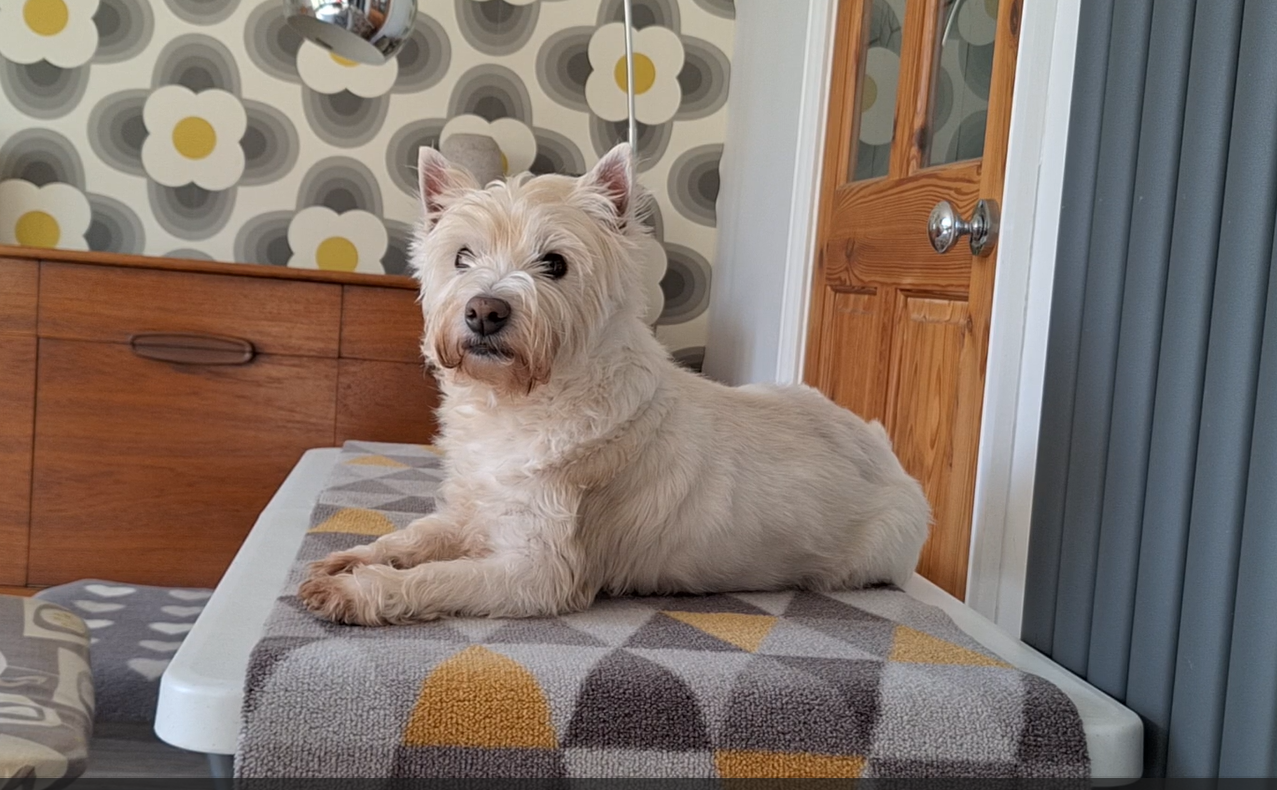
Case Study: Eddie the West Highland Terrier
Background
Eddie was referred to me after showing aggressive behaviours during grooming. He also had a skin condition that left red, sensitive patches, making grooming uncomfortable and increasing his anxiety around physical contact. He also had food allergies.
Early Sessions
At his first appointment, Eddie wouldn’t even approach me. I never approach new dogs — I allow them to process the environment and come to me when ready. Often when new dogs approach for the first time, they are just data gathering so it is important not to touch them during this time.
- Session 1: No approach
- Session 2: Mild curiosity, still no touch
- Session 3: First gentle stroke
During this third session, with his owners present, I introduced the steps to the grooming table. Eddie refused treats and wouldn’t get on the table for me, so I asked his owner, Lucy, to sit by the table and reward him for approaching the steps, then stepping on them, and eventually getting onto the table. Once he managed that, we had a “table celebration” with lots of positive reinforcement.
When Eddie became confident with the steps, I swapped places with Lucy and continued the training.
Teaching Table Protocol
I began by giving Eddie a small stroke while he was on the table, then allowing him to retreat. When he returned, he received a treat and another stroke. Dogs often learn that "on the table means touch, off the table means that touch will stop" incredibly quickly.
Once he understood the protocol, I introduced:
- Brushing
- Clippers
Scissors, however, were a firm no.
Identifying Sensitivities
Although some progress was made, Eddie struggled to focus for more than 10–15 minutes. Rather than force him to stay on the table with safety restraints, we looked at his potential triggers. We identified several triggers:
- Skin sensitivity
- Touch sensitivity
- Fear of scissors
- Dislike of harness (needed for car travel)
- Car anxiety (25-minute journey)
Removing the car and harness from the equation made a huge difference. Lucy purchased a height-adjustable table and caravan steps for home grooming. With me grooming him in his own environment, Eddie could focus long enough for a full clip-off using Table Protocol. I still avoid scissors, but he now allows clipper work on his face.
His groom isn’t breed-standard, and it wasn’t perfect at first—but it meets his welfare needs, and that is the priority. Grooms are getting aesthetically better all the time. Each time I visit he greets me excitedly at the door, then runs to get onto the grooming table ready for his clip.
Isn’t This Time-Consuming?
Not for most dogs. Many only need a few introductory sessions before they’re ready for standard grooming.
The more specialised approach I used with Eddie is reserved for dogs with multiple fears, pain issues, or anxiety. It’s deeply rewarding—and yes, it can be financially beneficial. My expertise allows me to charge higher fees.
Some dogs referred for aggression or difficulty grooming achieve a full groom within 4 sessions of 45–75 minutes. It’s about being a detective and tailoring the approach to the dog in front of you.
Benefits of the TTGOGS Approach
- Deeply rewarding work
- Transforming fearful dogs into willing partners
- Building trust and genuine partnership
- Financially sustainable due to specialist expertise
There’s nothing quite like seeing a dog who once avoided all interaction choose to work with you.
There are other benefits as well:
- Building better relationship with dog owners giving you the opportunity to educate them on not just only how to brush their dogs, but also providing advice and support if their dogs needs help with other issues and help them understand their dogs better.
- Partner up with like minded other canine professionals, such as behaviourists, trainers, vets, physios, etc., so that you can both cross refer but also work as a team to support some individual dogs and their owners.
- Become the "go to" groomer for dogs that struggle with grooming and handling, building you a specialist areas and reputation.
Do Owners Expect Perfect Grooms?
In my salon—rarely. I’m often the “last chance” before a lifetime of sedated clip-offs. I manage expectations before booking, and I’ve never had complaints about a groom looking “poor.” Many of my grooms fall below industry-standard aesthetics, but owners are delighted because their dog is comfortable, safe, and stress-free, and to be fair once I have found the formula to suit each dog, I do a pretty good pet trim.
There is a huge demand for groomers who follow the TTGOGS approach. I receive constant requests from owners and canine professionals seeking referrals.
How to Learn the TTGOGS Approach
I offer an online 1-2-1 Coaching Programme covering all the essential knowledge needed to follow the TTGOGS approach.
The programme includes webinars, 1:1 coaching; a Facebook group, group discussions, and recommendations for further study.
For further details please email info@happypawswithsue.co.uk